The advancement of online technology has drastically changed the way economies run, the way that people run, and information transfer. Schools across the globe are changing so as to include digital economics in classes. It is no longer the preserve of an economist or a policymaker to understand the economics of digital curriculum, but it is now upon students, professionals, and entrepreneurs of a technological world to understand.
The economics of digital curriculum as well. Digital curricula are useful in making students understand the value creation, exchange, and retention in the modern economies by breaking down the digital economic concepts into straightforward terms. Digital curriculum economics refers to a methodology of teaching the economics concepts in terms of the digital revolution’s effects on the concepts.
It shows the change in the way people used to do business in the old days due to information, sites, web-based services, and digital applications. As the number of online learning platforms and work-at-home and online businesses has risen, more accessible definitions of digital economics allow people of any kind to learn and practice this knowledge.
What Is the Digital Economy?
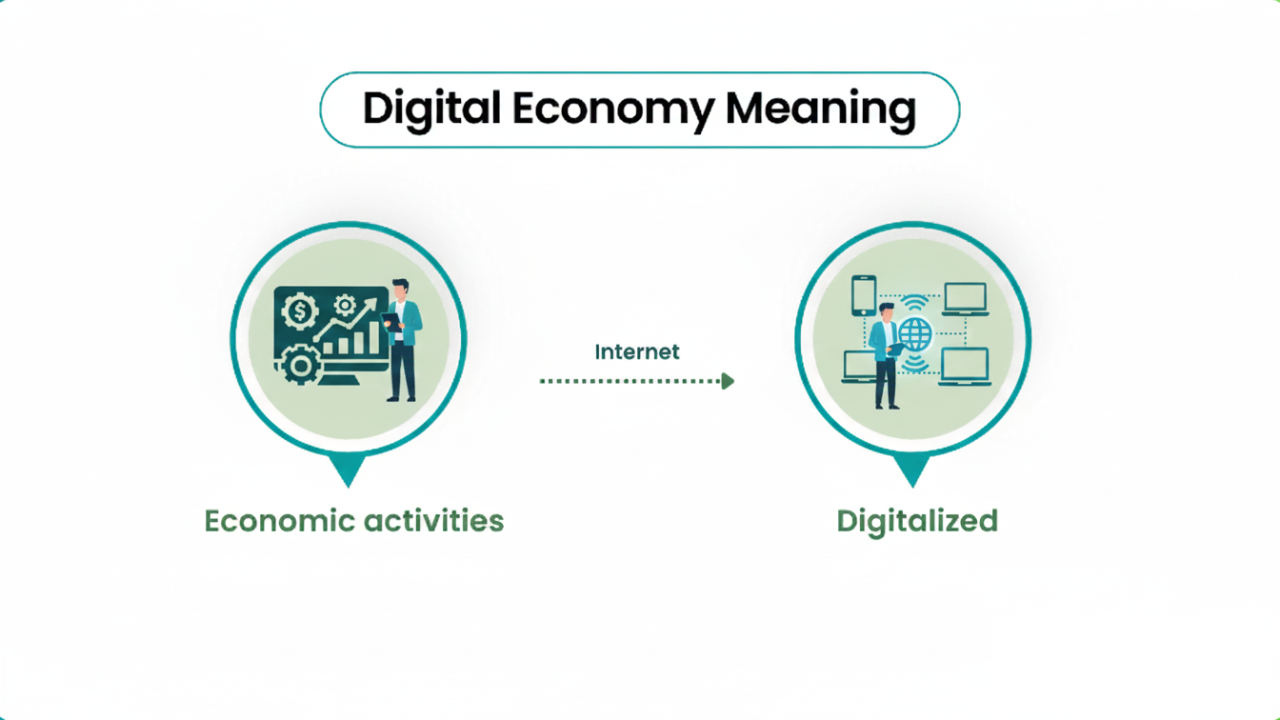
The digital economy is simply that part of the economy that is based on the digital technologies. This involves the conduct of businesses online, purchasing and selling items and services online, online delivery of services, application of mobile, and the management of data. Digital economy involves technology in a new rapid mode of building value in a globalized manner and not necessarily.
The corporeal goods and face-to-face transactions. Examples of the digital economy include online banking, digital payments, cloud computing services, and streaming services, to mention a few. The digital economy also includes the social networking sites whose income earned through advertisements. Such activities are highly critical and rely on information, connectivity, and digital fabric.
In terms of education, a definition of the digital economy would provide students with a concept of how the things they do on a day-to-day basis, like placing an order online for food or virtual classes, are a part of a bigger economic machine. These concepts also explained through digital curriculum economics, which aim at raising awareness amongst the students with regard to influence.
There are four significant types of economics, what are they?
One should be conversant with the basic form of economics in order to grasp the economics of digital curriculum. Traditionally, economics divided into four principal domains and the more we understand the economy, the more:
- Microeconomics: This part explores the decision-making process of individuals, which includes how consumers make a choice on what to buy and how companies make a choice on the pricing. The microeconomics offers an explanation of online pricing, online subscriptions, and consumer behavior in the digital world on online platforms.
- The field of macroeconomics is the economy as a whole, in other words, inflation, employment, and economic growth. Digital economies change the macroeconomic indices by introducing new sectors, enhancing the productivity of the working population, and changing the working market.
- International Economics: This course is interested in the manner in which countries carry out business and trade with each other. The virtual world has made it possible to do business beyond the boundaries, offer services at a distance, and be a freelancer anywhere on Earth. This makes online curriculum of international economics more important.
- Development Economics: This refers to research that interested in enhancing economies of the third world regions. Electronic devices like mobile banking, e-learning, and web-based markets very fundamental ensuring that all people are incorporated the economy and also to make it grow.
By presenting these four types in a simple and comprehensible manner, the digital curricula can guide the students towards learning to combine traditional economics theory and digital applications in the real world.
What are the three elements of the digital economy?
The digital economy consists of three important elements that help in its development and are still strong. To study the digital curriculum economics, you should know these pieces as well.
- The initial one is digital infrastructure. These comprise data centers, the cloud, the internet, and hardware like PCs and smartphones. Without a stable infrastructure, the digital economic activity can never be effective.
- The second is online services and platforms. The internet marketplace, payment services, social media, and software applications enable people to communicate, do business, and create value. It is easy to connect individuals, companies, and service providers within the digital ecosystems via these platforms.
- The final one is digital skills and information. The human capital is very important in the digital economy. The citizens included in the process in case they know how to code, analyze information, sell online, and communicate online. The so-called new oil is information, and it drives decisions, tailoring, and innovations in the digital sectors.
As a result, digital curriculum economics focuses on the interaction of these three elements to transform modern economies and create new opportunities for growth and employment.
Preparing to live in a Digital Future—Learning about Money
The pressure to study economic education in a convenient manner is rising with the pace of the digital revolution. The hard ideas taught through digital curriculum economics make it easier to understand because the concepts connected with real life and the prospects of working in the future. Providing easy means of explanation of the digital economy and learning.
The simplest forms of economics, and pointing to the most notable digital characteristics, allow the students to observe the whole picture of how the modern economies work. It is quite a convenient means of educating them in the classroom, but it also gives.
As a result, these tools are essential for enabling individuals to conduct business effectively in online markets. In an increasingly digital world, easy-to-understand and inclusive digital economic education becomes highly relevant for shaping a generation that is smart, adaptable, and resilient to economic disruptions. Ultimately, as global economic transformation continues to reshape education systems, such knowledge equips learners to navigate uncertainty and thrive in evolving digital economies.