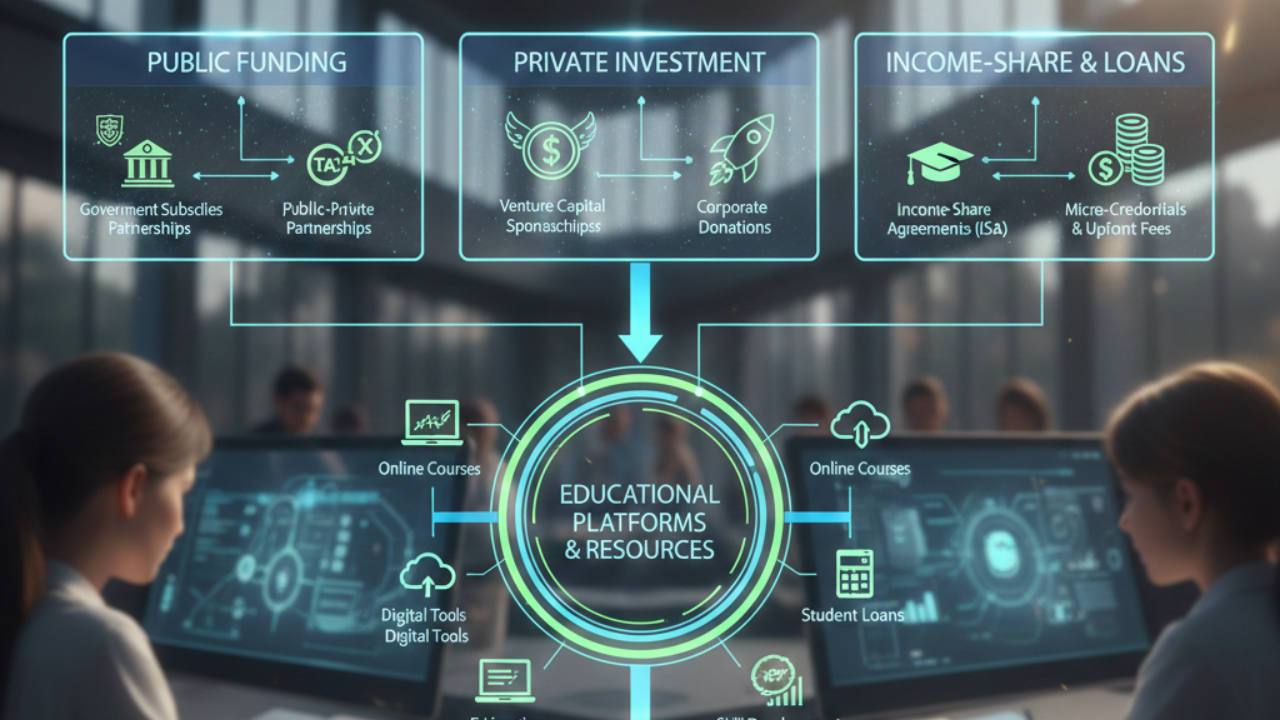
The fast pace of development of online learning has redefined disparate thinking about learning among the students, teachers, and schools. Online classes, virtual schools, and web platforms keep on gaining a major portion of the global education.a The big query with the convenience and accessibility of digital learning, however, is how they are funded.
Policymakers, schools, and students should aware of the financial process of digital education because it is one of the issues that determine the ease with which it can be accessed, the quality of the received education, and its sustainability. The people who aid in the funding of digital education are governments, business investors, schools, and even the students.
Each of the funding models has its strengths and weaknesses and its influence on the capacities of the students to learn and their performance level. The emergence of digital learning has allowed one to make smart decisions, brainstorm, and identify means through which each and every person can have access to a good education.
Government-sponsored Education online
Government financing is the most widespread way of financing electronic education. The government can contribute through grants, subsidies, or direct investment in internet infrastructure. Governments are aware that cheap and available education is important to economic development, training of individuals to work, and equity in society.
Digital projects funded by the government are typically directed at providing online courses in state schools, colleges, and tertiary education establishments. To take an example, the national schemes can make digital libraries, open educational resources (OERs) or even online education free to individuals. Such a plan enables the students to buy things with ease and quality learning materials.
Will acquired the areas that receive undercomplete supplies. Nevertheless, one may not be able to depend on government funds. The online courses may not sustained in case of budget cuts, administrative sluggishness, or change in political focus. The government-funded platforms also fail to be as flexible and innovative as the private or hybrid ones and that is why they are not able to adapt.
People and Companies Investment
The other sources of funding for digital education are also businesses, venture capital firms, and investors. Online course businesses, online learning platforms, and digital learning platforms tend to funded in order to develop new products, reach more customers, and improve on the quality of products they are offering.
A short time used in order to get innovation and growth through private investment. Colleges online, coding bootcamps, and skill-based learning vendors can have a chance to create new courses rapidly, launch some innovative technology, like AI or VR, and adjust to the changes in the market. Companies that invest in training and other professional development courses.
Behalf of their employees, they are also contributing to the development of the digital schooling and the preservation of the competitiveness of their employees. Despite its merits, the issue of private funding can increase expenses amongst students. This is because profit-making models will be able to impose tuition or subscription charges. Besides, the excessive reliance on the private investment may contribute.
Models Funded by Students
Students normally fund the education themselves by paying with any form of item, like tuition fees, course fees, or subscriptions. Direct form of payment allows students the option of using programs that they like and find within their budgets. That is where the money of most online universities, professional courses, and Massive Open Online Courses (MOOCs) comes in.
The student-based approaches give the student greater freedom, as they can pursue any course they desire as well as just paying what they need to. These methods also used to make the market more competitive, thereby compelling the providers to make more efforts to improve the quality of their courses and the user experience order to achieve better results.
However, even the paid-by-students models might make the access of everyone complicated. Students with poor backgrounds might not have the opportunity to participate because of high charges of tuition/subscription, and this is not likely to render digital education diverse and inclusive. To correct this, different providers have established scholarships, sliding-scale fee structures, or both.
On the front line of online learning
The online learning approaches are noteworthy to the future of learning. The models affect accessibility, creativity, and sustainability in such a number of ways as including government programs, corporate investment, student contributions, or community support. Some of the means of getting money should known to allow the corresponding stakeholders to make informed decisions.
Devise strategies of fair access, and allow learners of all areas to have access to quality education. It will be of immense importance to combine different types of funding in developing digital education systems that are robust, versatile, and available to everyone with the constant improvement of technologies and the desire of more people to learn online.
The opportunity to provide online education to millions of students all over the world generated only when it is planned properly and people cooperate. It can also help in sustaining the resources and innovative concepts that it needs to stay successful in a world where education is becoming increasingly digital.